Blog
From 1 January 2027, VAT payers in Slovakia send their domestic invoices as e-invoices over the Peppol network. But every company and every sole trader has to be able to receive them — including those who pay no VAT and will never issue an e-invoice themselves. Here is what applies, and a checklist of what to get done before the end of the year.
This article is based on the Slovak Financial Administration's answers to frequently asked questions about e-invoicing (version of 10 November 2026). The Financial Administration itself notes that they are not legally binding. Your accountant or tax adviser will confirm what exactly applies to your business.
What an e-invoice is, and why a PDF is not one
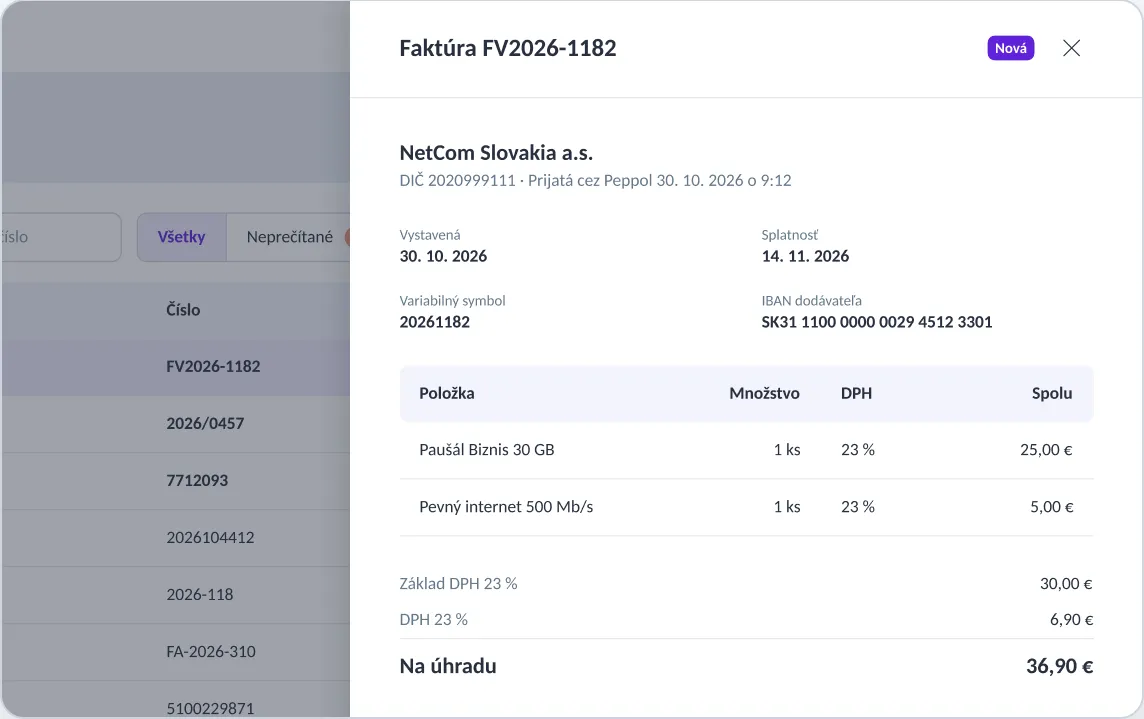
An e-invoice is an invoice issued, sent and received in a structured XML format under the European standard EN 16931. Accounting software reads it on its own, with no retyping of amounts and dates. A PDF is only a picture of the document: where the customer is to get an e-invoice, an invoice in PDF does not meet the legal requirement.
E-invoices are not sent by e-mail but through a delivery service on the Peppol network. The customer's consent is not needed for that. Any other route — e-mail, for example — is possible only with the recipient's consent.
Who is affected by mandatory e-invoicing in 2027
Issuing e-invoices is a duty of VAT payers — companies and sole traders alike — when they supply goods or services in Slovakia to another business or to a legal entity. Those who are not VAT payers do not have to issue e-invoices.
Receiving e-invoices is something every legal entity and every entrepreneur must be able to do: limited companies, sole traders, the liberal professions, independent farmers and landlords. This also applies to those who are not VAT payers. The Financial Administration says explicitly that a sole trader who receives no invoices today is not excused from getting ready: nobody can guarantee that a supplier obliged to invoice electronically will never send one.
The duty does not cover invoices to consumers or, for now, cross-border invoices. A VAT payer also does not have to issue an e-invoice for exempt supplies or for simplified invoices, that is a document of up to 100 euros or a receipt from an eKasa cash register of up to 400 euros. There are more exceptions and they depend on the particular supply, so go through them with a tax adviser. In addition, an amendment to the VAT Act was before parliament in November 2026 that is to adjust some details, such as an exception for some landlords. Watch its final wording.
What Peppol and a digital postman are
Peppol is a European network for the secure exchange of business documents between companies and public bodies. The Financial Administration compares it to a digital post office for invoices.
You do not connect to the network yourself but through a certified delivery service provider, known in Slovakia as a digital postman (digitálny poštár). The Financial Administration publishes the list of certified providers on its portal. The provider sets up your inbox for e-invoices, and the network finds you by your tax identification number (DIČ). You reach the provider through your accounting software or through its web application.
Two things are worth knowing in advance:
- For receiving, your DIČ can have only one provider. For sending you may use several.
- The provider reports the invoice data to the Financial Administration automatically. You fill in nothing by hand.
Key dates
- Until 31 December 2026 the voluntary period runs. You can send e-invoices already, provided your customer has a provider too.
- From 1 January 2027 e-invoices are mandatory for domestic supplies between businesses and to the public sector.
- From 1 July 2030 the duty is to extend to cross-border supplies. The Financial Administration links the same date with the end of the VAT control statement and the recapitulative statement; until then you keep filing them.
The deadline for issuing an invoice does not change: 15 days from the supply. But the e-invoice must also be sent within that period: creating it in the accounting software and leaving it there is not enough.
What happens if you are not ready
Without an inbox, an e-invoice from your supplier will not reach you. The supplier has met its duty simply by sending it through the delivery service. Whether it also sends it to you another way is up to the two of you.
According to the Financial Administration, a VAT payer who fails to report invoice data, or reports it incorrectly or late, faces a fine of up to 10,000 euros, and up to 100,000 euros for a repeated breach.
A checklist for the rest of the year
- Check your DIČ. The network identifies you by it. If you only have a company ID (IČO), ask the tax office for registration and a DIČ.
- Choose a digital postman. Decide whether you want to handle e-invoices in your accounting software or in a separate application.
- Confirm the choice in the Financial Administration's application. Every company has to select its provider itself in the VPDS application. See our guide to selecting a provider in VPDS.
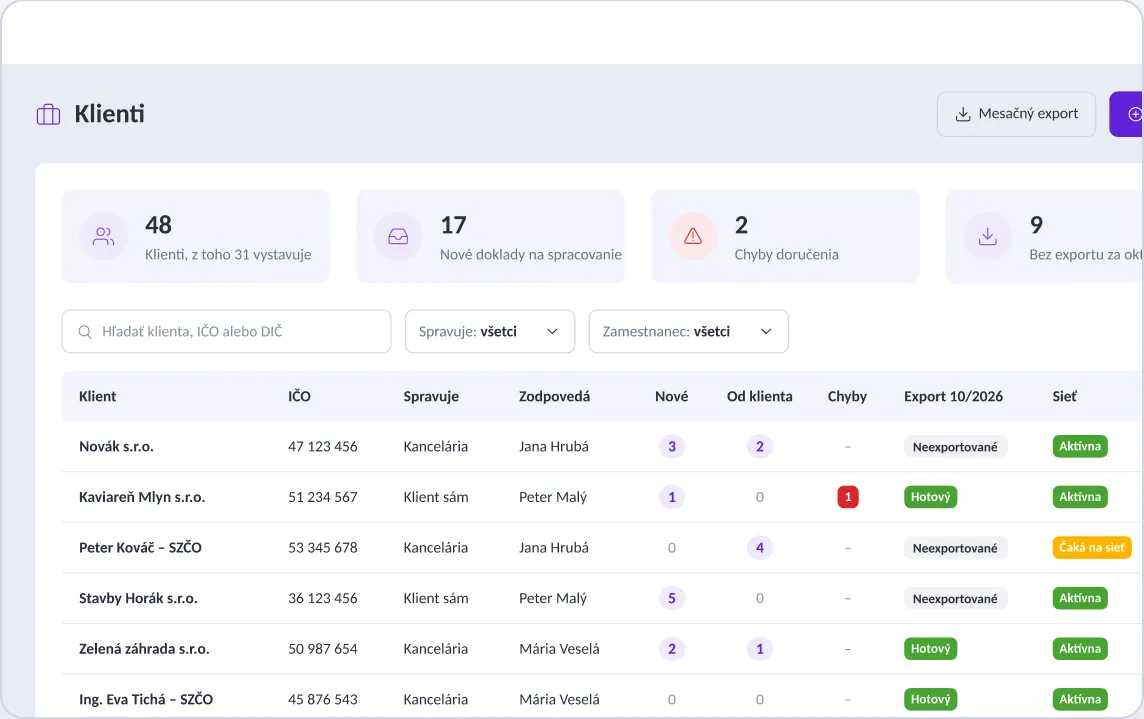
- Agree with your accountant. Either give them access to the provider's application, or export the invoices for them once a month. If you are a client of an accounting office, it can run the inbox for you: see e-invoices for accounting offices.
- If you are a VAT payer, try issuing one. Make sure your invoicing software can both create and send an e-invoice, and send one in December to a customer who already has an inbox.
- Complete your customers' DIČ. It is the address an e-invoice is delivered to on the network.
- Think of the archive. A VAT payer must keep e-invoices for ten years from the end of the year they relate to, in the original XML format.
How Planmee eFaktúra solves it
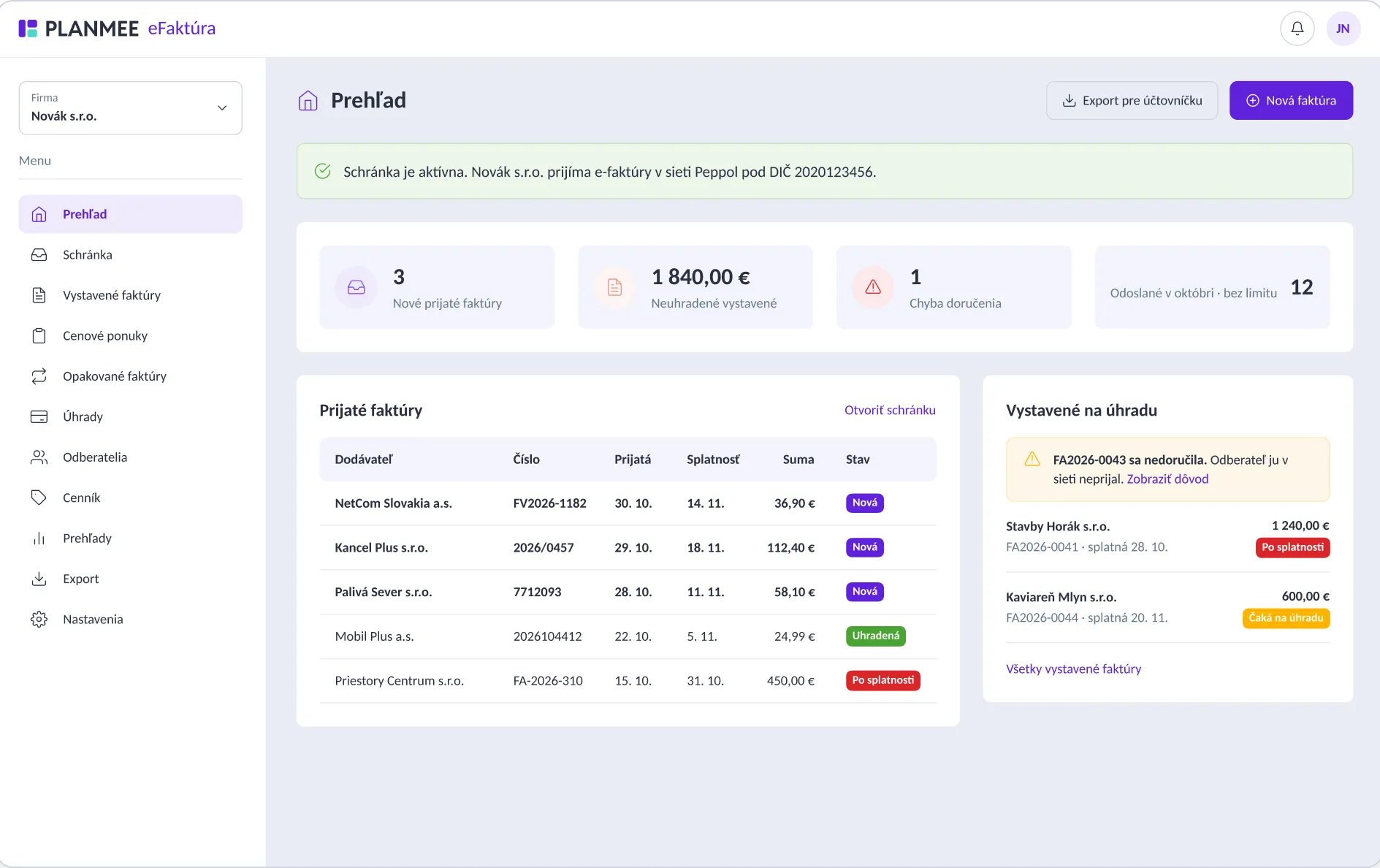
Planmee eFaktúra is an e-invoice inbox and invoicing in one web application, with nothing to install. Planmee is a certified delivery service provider, so you get your inbox on the Peppol network directly from us.
- The inbox is free forever: unlimited receiving of e-invoices, three issued invoices a month, access for your accountant and a 10-year archive.
- Unlimited issuing costs €2 a month on the Invoicing plan when billed yearly (€24 a year, or €2.90 paid monthly). We do not count invoices.
- A check before sending: we find the customer by their company ID and verify that they receive e-invoices. You then see the delivery status of every invoice.
Prices exclude VAT. For comparison: the Financial Administration expects the subscription to a simple provider application not to exceed the EU average of 5 to 12 euros a month. Those who register by 31 December 2026 get the first three months free and the price locked for 12 months.
Subscribe to our newsletter
Stay up to date with our latest articles and product updates, please subscribe to our blog newsletter.
Share